Ward vision that actually wins pubs
I used to buy one sentry at minute twelve, pat myself on the back, then wonder why their offlaner kept showing up mid. The problem was not my team. It was timing.
Why most ward guides fail in ranked pubs
Most ward content on the internet is written by someone watching a pro VOD with a spreadsheet open, mapping every Observer to a minute-perfect timing chart borrowed from a team scrim. That advice assumes five players who talk, five players who buy the correct item on the correct minute, and a support who never gets distracted farming a jungle camp because the lane got boring. None of that describes a ranked pub. Pubs are chaos with a scoreboard, and a vision plan built for TI grand finals collapses the moment your safelane support decides wards are optional and your carry pulls the trigger on a fight nobody scouted.
This guide is written for the bracket where one honest Observer and one used Sentry change more games than a theoretically perfect item build. If you queue solo, you cannot control whether your team wards. You can control your own vision discipline, and that alone moves games. Pair the habits below with our map awareness guide so you actually look at the wards you place, and read the cooldown tracking guide so vision and spell timing reinforce each other instead of living in separate mental drawers.
For public hero and lane data while you build these habits, browse OpenDota and objective breakdowns on Liquipedia. Numbers are useful context. They do not replace the habit of actually walking to a ward spot at the right minute with the right item in your inventory.
The myth of "I warded"
Somewhere between 2k and 4k MMR, vision turns into a checkbox instead of a decision. A player buys one Observer, drops it near the river on the way to a rune, types "warded" in chat, and mentally closes the topic for the next five minutes. Then Roshan dies with zero vision on the pit, the enemy offlaner walks a jungle path nobody covered, and someone flames the support for "no wards" even though a ward has been sitting in a useless bush the entire time. The ward existed. The information did not.
Vision is not decoration you place to satisfy an achievement. It is tempo. A ward placed with intent buys you a real decision: smoke now, farm safely, or reset to base. A ward placed out of habit buys false confidence while four enemy heroes route around it without you ever knowing. If your only vision trigger is "we just died, better ward," you are permanently one step behind the game instead of shaping it.
The fix is boring but works: before you place a ward, say out loud (even just in your head) what question it answers. "Does this see the safelane pull camp." "Does this see the Roshan pit entrance." "Does this see the path their mid takes to gank bottom." If you cannot answer that question, you are about to waste three hundred gold on a decoration, and decorations do not win pubs.
Timing beats placement charts
Placement charts are fine training wheels for someone who has never bought a ward in their life. They are useless the moment you ignore when the enemy support actually left lane. If their position four vanishes from bottom lane at 3:50, that single data point matters more than any generic chart telling you to ward the river triangle at minute four. The real question is where did they go and what does their absence let the enemy carry do right now.
Write it down for a week, literally in a notes app if you have to. Track the minute enemy supports leave lane, the minute they reappear, and what happened in between. Patterns show up faster than any guide promises, because pub players are creatures of habit even more than pros are. Combine that written habit with a cooldown tracking routine so you can tell the difference between a real threat rotation and a bait that wants you to overextend chasing lane kills.
- Buy detection on your way out of the fountain after any team wipe, not as an afterthought later.
- Clear known vision before you take a risky jungle path with your carry.
- Treat every Roshan window as a vision objective first and a damage-check second.
- If your team consistently refuses to deward, play as if the entire map is hostile until you personally prove otherwise.
- Do not waste a Sentry clearing a cliff you already checked thirty seconds earlier just because you are standing near it.
Lane stage vision, minutes 0 to 12
Early wards exist to answer one narrow question: who can safely leave their lane without dying to something invisible. Mid needs river vision and rune-side block information so a gank does not appear out of nowhere while they are farming a wave. The safelane needs pull-camp coverage and early information on when the enemy offlane support disappears to threaten a three. The offlane needs eyes on the pull camp and on the path enemy supports take when they walk behind the tree line to double up on a hero who cannot fight back.
If your minute three ward answers none of those questions, it is cosplay, not strategy. Spend early gold on information that protects farm, because a "perfectly placed" ward on the wrong side of the map while your carry dies anyway is still a dead carry and a lost tempo swing. When enemy supports roam, your Observer needs to cover the actual path they walk, not the path a chart from a completely different draft told you to expect.
This stage is also where deward habits should start forming, even though most players save Sentries for the midgame. A single Sentry that clears an early pull-camp ward can flip an entire lane, because the enemy support suddenly has to walk back out in the open to re-establish vision, and that walk itself is information for your team.
Mid game vision and smoke defense
Once laning ends, wards shift from lane protection into smoke defense and objective preparation. The rule is simple to say and hard to follow under pressure: place deep information before you actually want to push, not after your team is already standing on the enemy high ground wondering why five heroes just appeared from a smoke you never saw coming. If you are ahead, ward the enemy triangle and the path toward their ancient camp. If you are behind, ward your own jungle exits so your core can farm without feeding a gank that was entirely preventable.
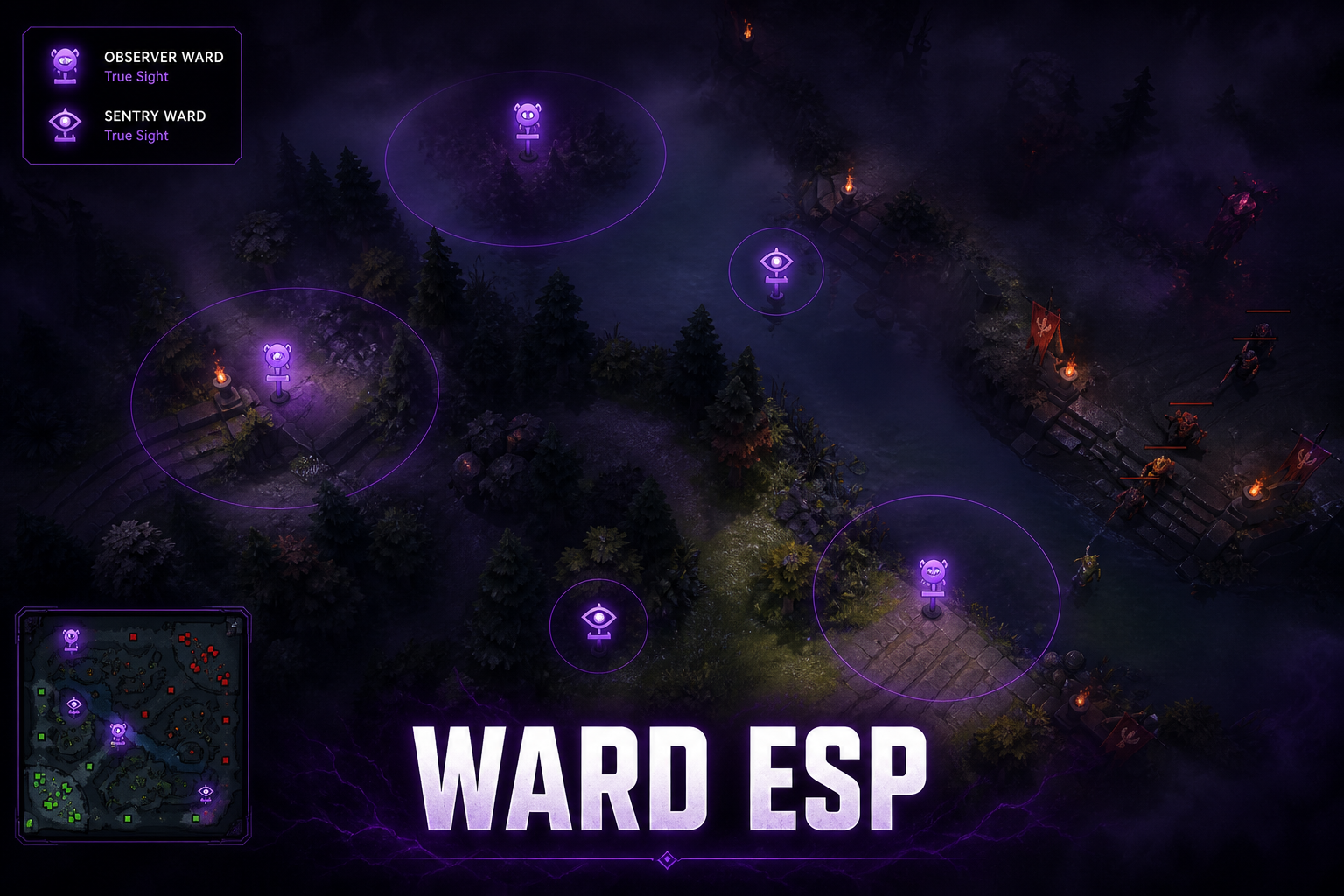
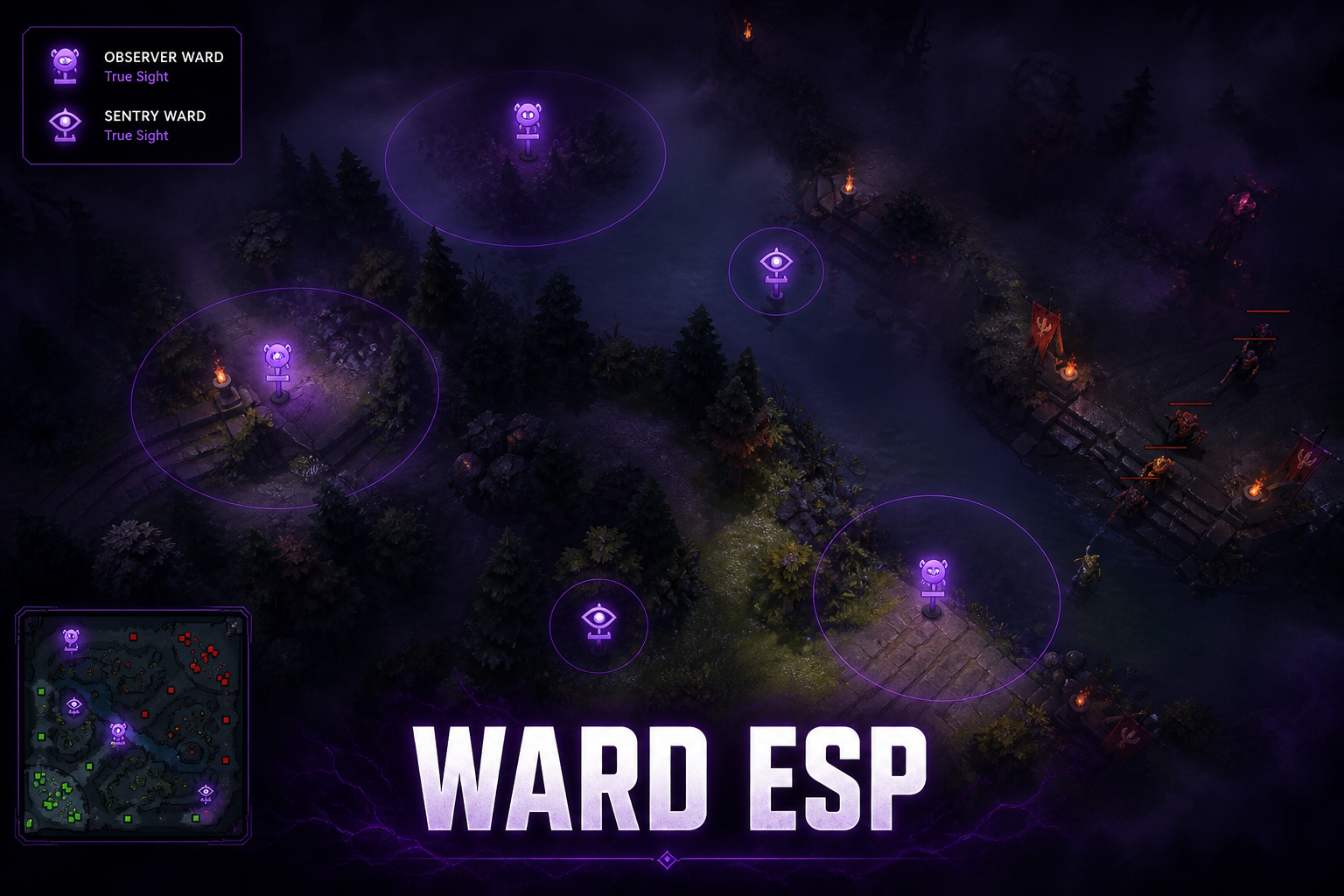
Smoke plays fail constantly in pubs for one repeatable reason: someone shows up on an old Observer that has been sitting dead for ninety seconds, or the enemy simply walked a route with zero vision on it. Check the map immediately before your team smokes, every single time, even if it feels redundant. If you use overlay tooling to learn these routes faster, ward ESP style features from DOTA2 Cheats are genuinely useful for internalizing common smoke paths, but they should train the habit of checking, not replace the habit itself.
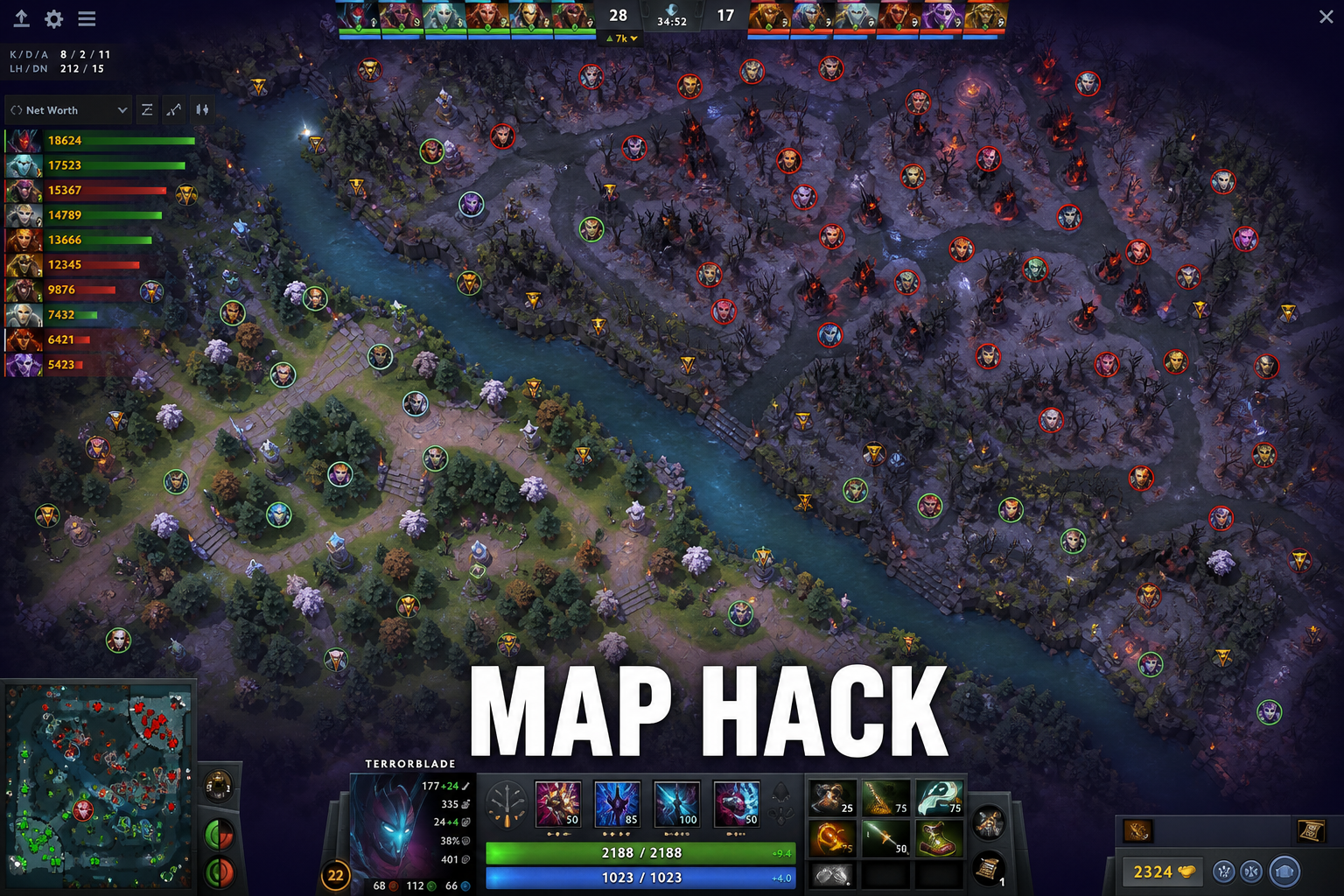
Midgame is also when Observer count per team should climb from one at a time to a rotating pair. One ward covering your farming path, one covering the objective you are about to contest. If your team is only ever placing a single ward at a time in the midgame, someone is under-warding, and it is usually worth being the one who fixes that instead of waiting for a support who has already tunnel-visioned onto last hits.
Roshan vision is a separate game
Roshan without vision is not a calculated risk, it is a coin flip wearing a strategy costume. Read our dedicated Roshan timer guide for the full timing breakdown, but the vision-specific checklist is short. Before any Roshan attempt, you need to have cleared nearby enemy sentries, placed an Observer that actually sees the pit entrance rather than a nearby tree line that only sees half of it, and confirmed whether the enemy mid ultimate is up. If you cannot answer all three, you are gambling with a five-person buy-in.
The pit itself has known weak angles that pub teams check inconsistently. The uphill entrance near radiant jungle and the downhill approach from dire side both have blind spots that a single poorly placed Observer will not cover. Teams that win Roshan fights consistently in pubs are not smarter about damage output, they are simply the team that is not surprised by a fourth enemy hero walking in from an angle nobody warded.
- Confirm nearby enemy Sentries are cleared before committing damage to Roshan.
- Place an Observer with a sightline directly into the pit entrance, not just the general area.
- Track whether the enemy hero with the biggest teamfight ultimate has it available before you start the fight.
Deward routes by role
Carry players tend to hate this next sentence, but it is true anyway: one good Observer wipe is worth roughly two creep waves of value if it prevents a smoke gank that ends your entire game. Carrying a spare Sentry when you leave base after a death costs almost nothing and pays for itself the first time it saves your life or your team's initiation. Check the classic cliff spots and pull camps before you casually walk into the ancient camp "because gold is gold." Dead heroes do not get to cash in gold, and a dead carry sets your farm curve back by minutes you cannot recover.
Support players carry the bulk of the actual dewarding responsibility, and the mistake most support players make is waiting for the carry to ask before buying a Sentry. Do not wait. Buy it yourself, walk the known cliff, clear it, and move on with your day. Communication that arrives after your team has already wiped to a smoke is communication that arrived too late to matter, no matter how correct it was.
Mid players and offlaners have a narrower but still real deward job: clearing vision near your own farming triangle so you are not feeding information about your own item timings and cooldown availability to a support who has been camping a ward all game. If you are the hero the enemy team is trying to gank the most, you have the strongest personal incentive to carry detection even if your build does not naturally want the inventory slot.
Reading enemy ward patterns
Enemy vision is not random, especially in pubs where players repeat the same habits game after game. Watch where the first ward death of the game comes from and you often learn the enemy support's default routine for the rest of the match. Supports who ward the same river spot at the same minute every single game are giving you a free deward route if you simply pay attention during the first ten minutes instead of tunnel visioning on your own lane.
Bracket also predicts pattern rigidity. Lower bracket supports tend to ward extremely predictable spots because they learned one "safe" placement and never varied it. Higher bracket supports rotate placements specifically to punish predictable deward routes, which means the counter-play shifts from "clear the known spot" to "clear the spots that deny information about rotations," a subtler and more valuable target. Recognizing which bracket habit you are facing changes how much time you should spend hunting wards versus simply playing around assumed vision.
A practical trick: after the first team fight or first Roshan attempt, note exactly where the enemy support was standing when the fight started. That location plus the fight outcome usually reveals a ward nearby that gave them the information to engage or disengage correctly. Clearing that specific ward before your next contested objective removes their advantage at the exact moment it matters most.
Observer versus Sentry economy
Pub teams chronically underspend on Sentries relative to Observers, mostly because Observers feel proactive and Sentries feel reactive, even though both cost the same and both win games. A rough economy that works across most brackets: for every two Observers your team places, at least one Sentry should be walking around clearing enemy vision or protecting an objective attempt. If your team's ward count is entirely Observers with zero Sentries by minute fifteen, you are playing half the vision game and wondering why the enemy always seems to know where you are.
The gold cost argument against Sentries falls apart quickly once you count how much gold a single unseen gank costs versus how much gold a Sentry costs. A support death from an unwarded smoke play often costs more gold and more tempo than ten Sentries combined would have cost across the whole game. Treat detection spending as insurance, not luxury, and the math works in your favor almost every time.
- Rotate Observer duty between both supports rather than leaving it entirely to one player.
- Keep at least one Sentry in reserve at all times after the ten minute mark.
- Buy Sentries proactively before objectives, not only reactively after a death.
Common vision mistakes by MMR bracket
Herald and Guardian games usually suffer from total vision absence rather than bad vision. Wards simply are not purchased, Sentries are treated as a mystery item nobody understands, and most deaths come from zero information rather than misread information. The fix at this bracket is embarrassingly simple: buy any Observer, place it anywhere near where fights actually happen, and you will already outperform half the lobby.
Crusader and Archon games introduce the "I warded" checkbox problem described earlier. Wards exist but are placed without intent, dewarding is almost nonexistent, and Roshan attempts happen blind more often than not. The fix here is intent: ask what question each ward answers before you place it.
Legend and Ancient games start showing real deward habits and smarter placement, but timing discipline is inconsistent. Players know where to ward but forget when the window matters most, missing the exact minute an enemy rotation becomes threatening because they are focused on last hits instead of the clock.
Divine and Immortal pubs generally have solid individual vision habits but weaker team-wide vision economy. Individual players ward correctly for their own lane but nobody is thinking about map-wide coverage, leaving predictable gaps around Roshan and high ground pushes that a coordinated deward from the enemy exploits immediately.
A weekly practice drill for vision habits
Pick five games over the course of a week where you commit to a single rule: never place a ward without first stating, even silently, the specific question it answers. After each game, review your own vision score if your client tracks it, or simply recall out loud how many of your wards actually influenced a decision versus how many just sat there unused. Be honest. The point of the drill is not your win rate for the week, it is building the intent habit until it becomes automatic.
A second version of this drill works well for support players specifically: commit to buying and using at least one Sentry per game cycle from base, even if your team does not ask for it. Track whether the Sentry clear ever directly prevented a death or enabled a kill. Over five to ten games the pattern becomes obvious, and most players are shocked at how often a single proactive Sentry changes a fight outcome.
Where tools like ward ESP on DOTA2 Cheats help
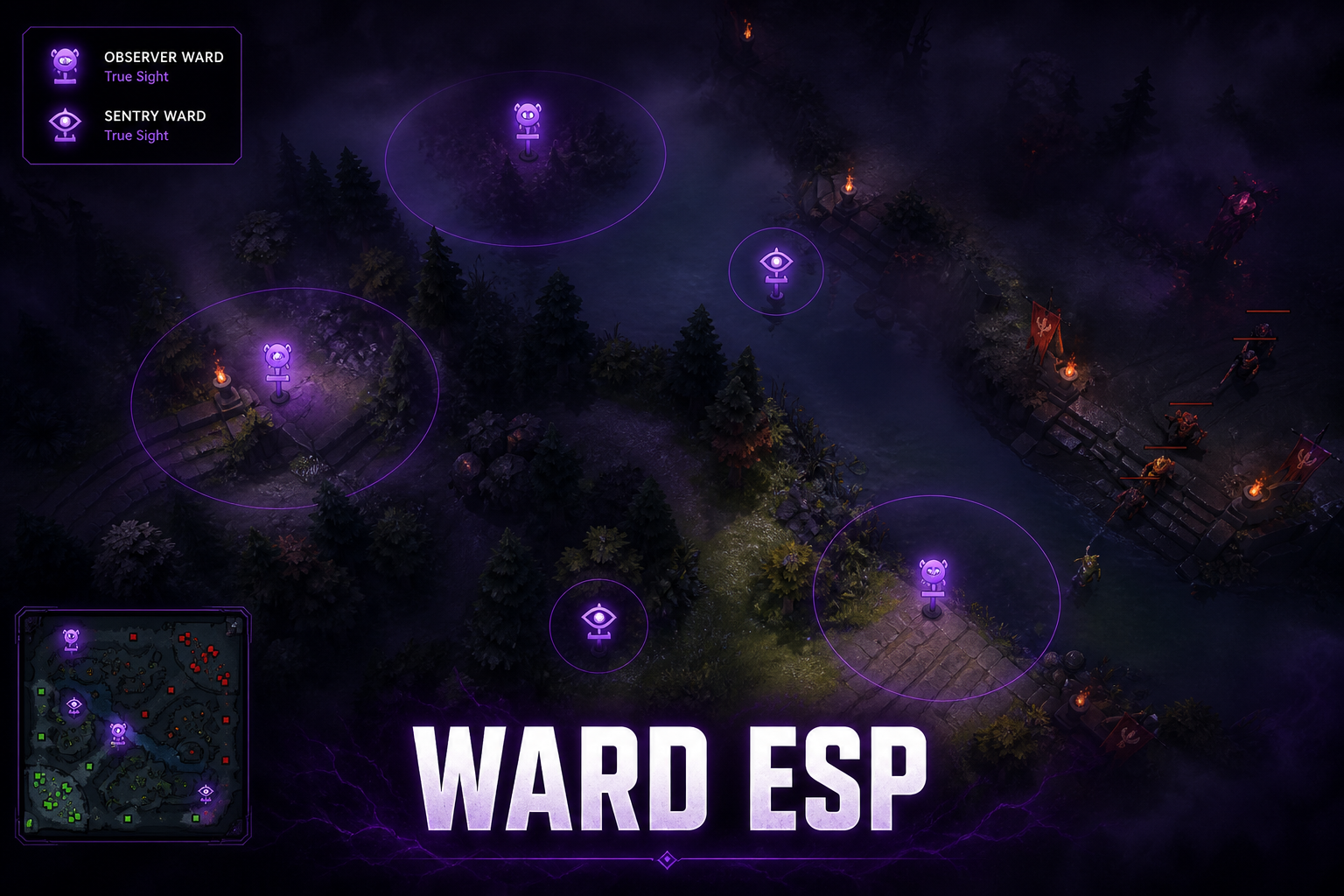
Some players use ward ESP and map tools from DOTA2 Cheats specifically to compress the learning curve on where enemy vision typically sits and where deward routes actually pay off. Fair or not as a debate, pubs already punish incomplete information constantly, and the honest use case for this kind of tool is training: see enemy ward spots enough times and you start predicting them without the overlay, the same way any repeated pattern eventually becomes intuition.
Used correctly, tooling accelerates habit formation instead of replacing it. Use it to verify your deward routes, confirm your smoke reads before a push, and check your Roshan setups until the checklist becomes muscle memory. Do not use it as a substitute for the discipline of actually walking the deward path or actually checking the map before you commit to a fight, because the overlay only tells you what exists, not what you should do about it.
Setup and licensing questions for any of this live on our FAQs page. Whatever your stance on tooling, the underlying habits in this guide, intent-based warding, timing over charts, proactive dewarding, and honest weekly review, will move your games regardless of what overlay you do or do not run.
Vision priorities against specific hero archetypes
Not every enemy draft demands the same vision plan, and treating every game with an identical ward pattern wastes gold against threats that need a different answer. Against a draft with strong mobility, heroes who can blink or teleport into your farming lanes without warning, prioritize deep jungle Observers over river vision, since the danger comes from inside your own territory rather than from an obvious approach path you can already predict from lane positioning.
Against a draft built around invisibility, whether that is a hero with a fade ability or an item-based invisibility strategy, Sentry economy matters more than Observer count. A team facing a strong invisibility pick that only buys one or two Sentries across the entire game is choosing to play blind against the exact threat that vision items exist to counter, and that choice usually shows up as a string of unexplained deaths in the replay.
Against a draft focused on split pushing multiple lanes at once, vision priorities shift toward your own base perimeter and the approach paths to your outer towers, since the threat is not a single coordinated push but a constant trickle of pressure across the map that needs early warning rather than a single concentrated ward cluster. Adjust your ward budget to the actual shape of the threat in front of you rather than a generic template.
Communicating vision information in solo queue
Vision only creates value once it reaches a decision, and in solo queue that means the information has to travel from your eyes to a teammate's decision making with almost no shared context or trust built up beforehand. A ping on the minimap combined with a short, specific chat message beats a vague "care" message that could mean anything from an incoming gank to a wasted Roshan attempt three lanes away.
Specificity is the entire game here. "Care mid, invis gap" tells a teammate exactly what to do with the information. "Care" by itself gets ignored more often than not, simply because it does not tell the recipient what action to take or how urgently to take it. The extra three seconds it takes to type a specific call pays for itself the first time it actually prevents a death instead of blending into the background noise of pub chat.
Communicating vision gaps matters just as much as communicating vision gained. Telling your team "no wards up top" before a push is just as valuable as telling them where an enemy ward sits, since it sets expectations about the risk level of a play before anyone commits resources to it.
Warding around Tormentors and other newer objectives
Newer map objectives like the Tormentor camps demand their own vision plan the same way Roshan does, and pub teams frequently forget this because the habit of warding Roshan is older and more ingrained. Before attempting a Tormentor kill, the same basic checklist applies: clear nearby enemy Sentries, place an Observer that actually covers the approach paths, and confirm whether the enemy's biggest teamfight threat has their ultimate available in case the attempt gets contested.
Outposts also generate a recurring vision and information opportunity that pub players undervalue. Controlling the vision radius around an outpost gives early warning on rotations through that side of the map, and contesting outpost vision, not just outpost experience, is worth factoring into your ward budget particularly in the midgame when rotations through that area become more frequent.